

The time has come, the bots have taken over — or at least when it comes to HTTP requests to HTML content.
Last week, Cloudflare data on worldwide traffic showed that bots now outnumber humans on search requests, in a tipping point that Cloudflare CEO Matthew Prince said he wasn’t expecting until 2027.
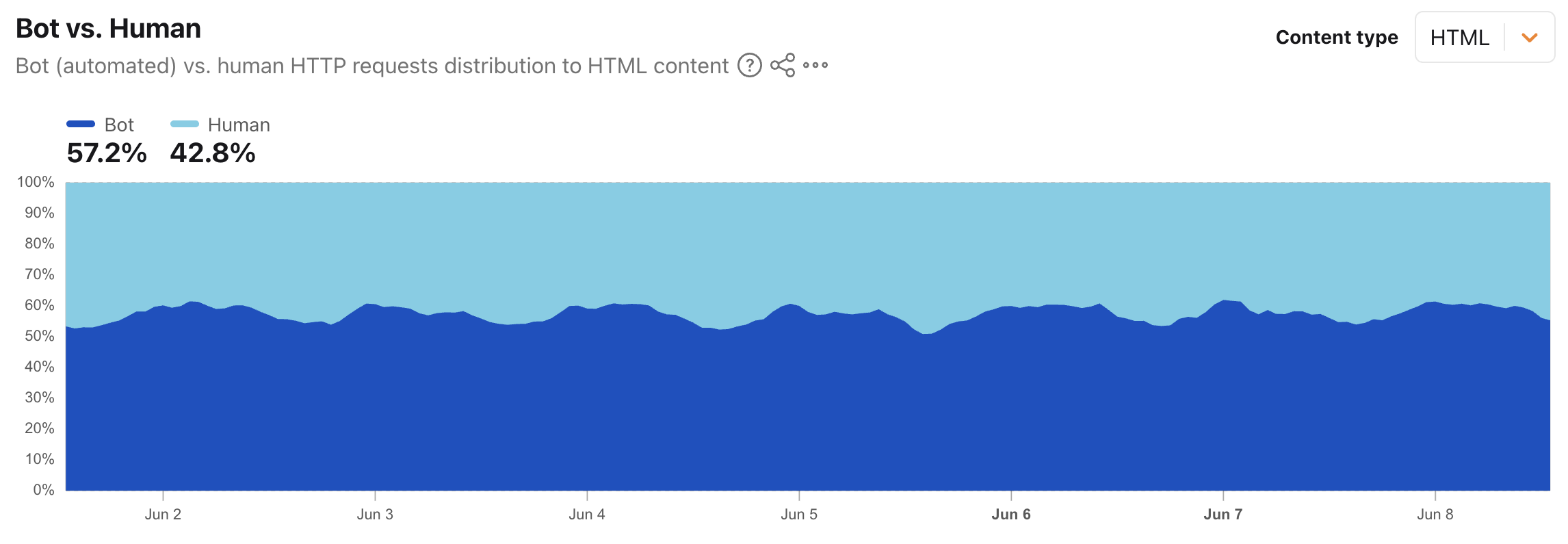
As of today, 57.2% of HTTP requests to HTML content are being generated by bots, compared to 42.8% from humans.
“Welp, that happened faster than I predicted,” said Prince, in a post on X, adding that agentic traffic had driven this world-first.
Indeed, in the last few years, we’ve seen LLM usage skyrocket — just this month, ChatGPT reached 1 billion global monthly active app users.
Zoning in on the geographic bot traffic hotspots, according to Cloudflare, Gibraltar comes in first, with 92.8%, followed by Singapore (76.3%), Iran (75.5%), Ireland (72.4%) and American Samoa (68.8%).
Welp, that happened faster than I predicted. Thought it would be end of 2027, then early 2027, but agentic traffic growing so fast that bots have now passed human traffic online for the first time in the Internet's history. https://t.co/2zX5bHdhsa
— Matthew Prince 🌥 (@eastdakota) June 3, 2026
The implications? According to Cloudflare’s Prince, it’s going to be pay to crawl: “Now just need the protocols and infrastructure to support the volume it’ll require. Working on it.”
The company launched its own AI Crawl Control feature last year.
The CEO also noted that the data raises questions about the internet’s business model — when such a large portion of traffic is derived from bots, ads don’t get clicks. One way to approach this is charging bots for access, something he said could make the internet free for humans again.
The latest Cloudflare data comes as the affiliate and performance marketing industry works on its own strategy to compete in the new zero-click world, with an emphasis on tracking and remunerating influence across the funnel.
Considering the rate of AI evolution, how the internet will look by 2027 is anyone’s guess, but for Prince, when it comes to traffic, it’s “clearly on the other side now.”


