
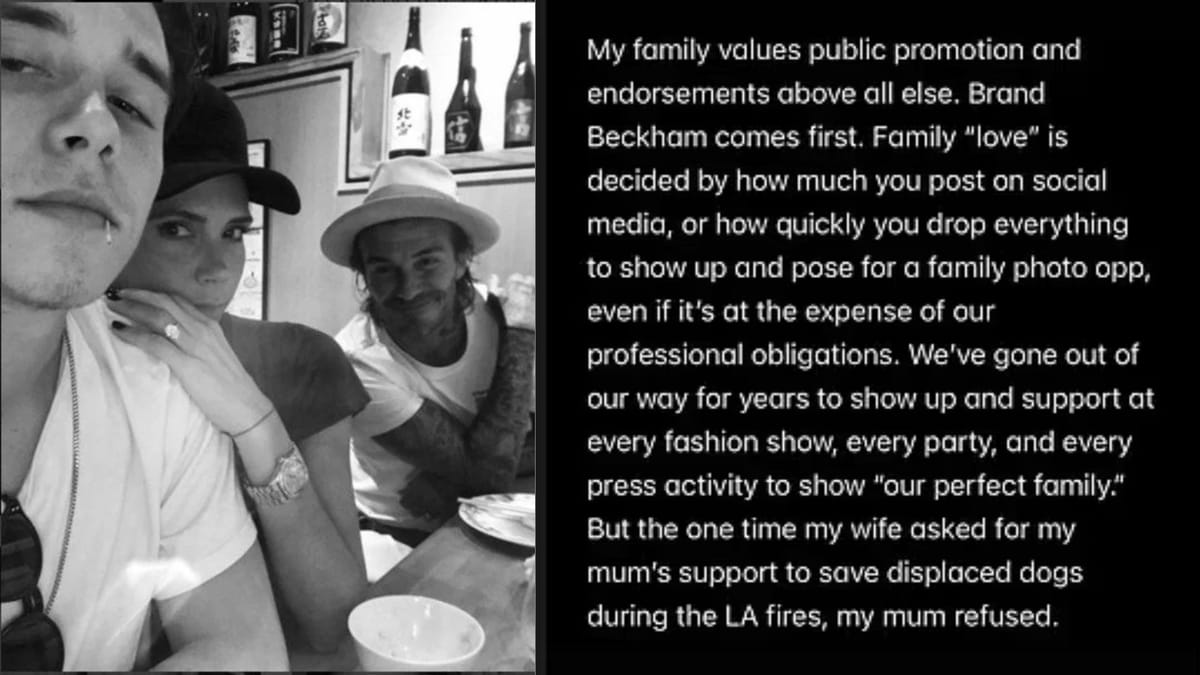
Brooklyn Peltz-Beckham sparked widespread online discussion on Monday evening after sharing a series of public statements addressing tensions within his family. As one of the most famous families in the world, the public nature of this fallout places the Beckham brand in dangerous territory.
PR expert and influencer Dan Harry took to TikTok to estimate how much crisis management efforts could cost if the family chooses to actively address potential reputational impact.
@danharrypr Replying to @Phil how much will the beckhams scandal cost them in PR? #pr #beckhams
♬ original sound - Dan Harry
In the video, Harry breaks down the estimated costs associated with managing a high-profile family scandal of this scale, factoring in crisis communications, media strategy, brand protection, and long-term reputation repair.
He notes that they’re likely to already have a UK and US PR Agency, but the cost of hiring a specialist crisis management agency will be high.
“The publicists or agencies they work with will need to be the most senior in the game, and those people can charge up to £2,000 an hour for the work.”
He also notes that any crisis response would need to be closely coordinated with legal teams, adding further cost and complexity to the process.
So what about the timeline? Harry suggests that now it’ll be planning and strategising, with recovery put into place over the next six months, give or take.
With consideration for handling media requests, bombshell stories and the drip feeding of information, he estimates that the Beckhams could be looking at costs of upwards of £500,000.
Beyond the financial cost of crisis management
Speaking about crisis management more broadly, Pepper co-founder Beckii Flint previously discussed the importance of trust and audience understanding during a LinkedIn livestream with Hello Partner in October.
When asked how brands can best control damage in dire situations, Flint stressed the importance of knowing your brand and audience well enough in the first place.
“Marketing works so well because it’s built on trust. If an audience no longer has that trust, that’s the end of the relationship. It can be career-ending.”
“Brands must build that respect for the audience early into the process. It’s important to take a beat and understand your audience. One thing that was really eye-opening for me was understanding the difference between good and bad faith interpretations of things on the internet, and it does become black and white after that. You can post the most benign thing, and it can quickly spiral out of control when it wasn’t your intention at all.”
She was also quick to catch the classic forms of apologies, including the classic creator notes app special.
“We’re all familiar with the concept of a notes app apology. These are nuances that we have in internet culture because they happen so many times now. The cycle of cancel culture we live in now, we’ve seen a variety of apologies - some of which have worked, and some have fallen flat.”
But ultimately, she acknowledged that it’s all about actions instead of words in the end.
“It’s not just about paying lip service, but showing what actions you’ll take to make amends.”
Be a part of our State of the Creator Economy 2026 Report!
Share your thoughts and get early access to the report, as well as a chance to win a £100 Amazon voucher! Each survey takes less than 3 minutes to complete:
Brands | Influencer Marketers | Talent Agencies | Creators